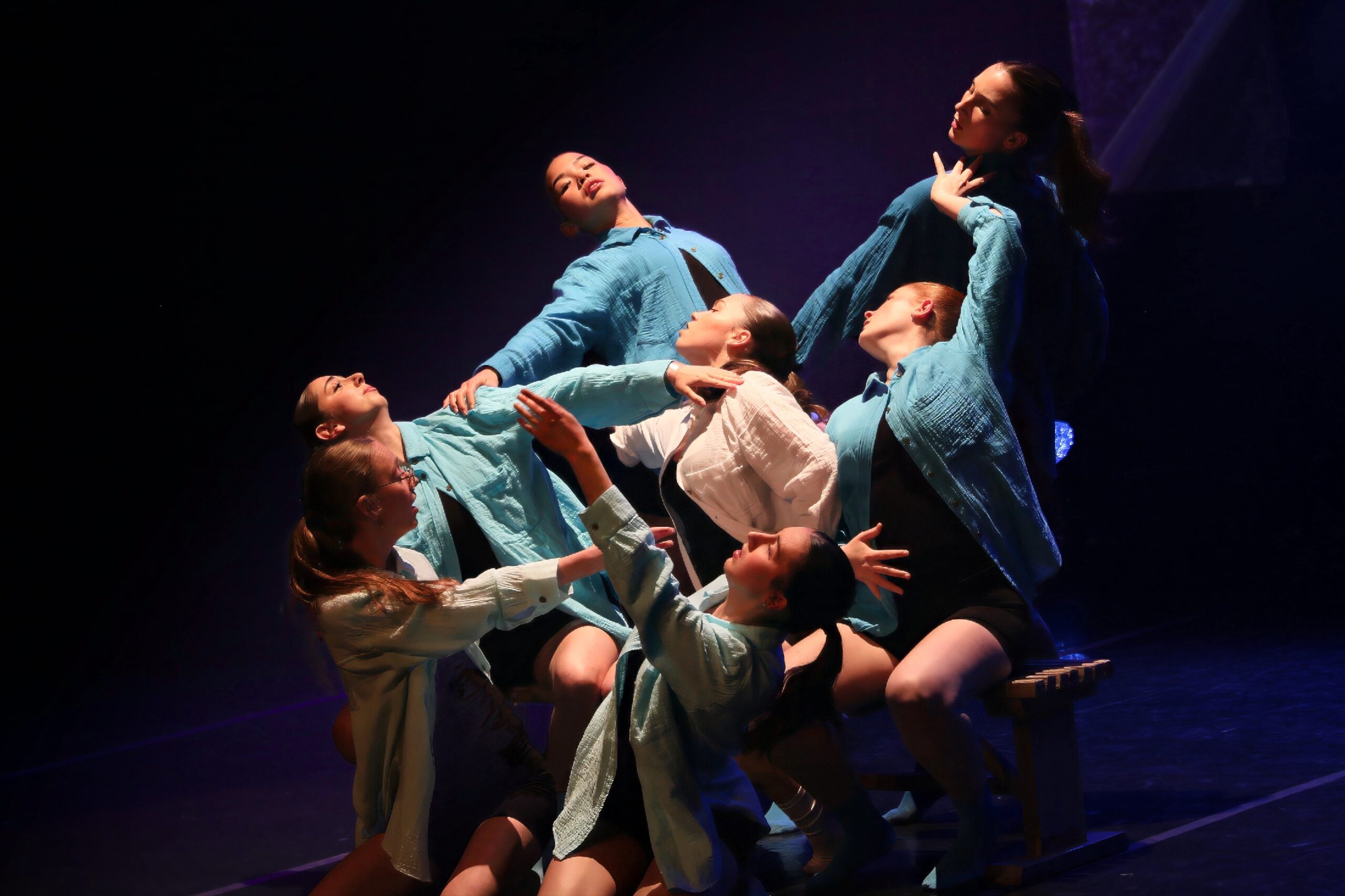
Photographing a dance troupe during a number is a beautiful challenge.
What makes it difficult is that, most of the time, we were not there during the regular practices. We do not know the choreography in advance. We do not know exactly what is going to happen, who will move where, who will jump, who will be in front, who will be hidden behind someone else, or when an important moment will happen in the number.
So we have to photograph while constantly anticipating.
We try to predict the movement, choose a good angle, and quickly understand the choreography, but at the same time, we have to accept that we will not control everything. That is why, in this type of situation, I often prefer to photograph a little wider, just to make sure I capture the full movement.
Because in dance photography, small details matter a lot: the tips of the feet, the hands, the full head, the posture, the movement of the body, and the expression on the dancer’s face. If the frame is too tight and a foot or a hand is cut during a jump, the photo loses a big part of its impact.
Every Dance Style Has Its Own Challenges
Depending on the style of dance, we are not always looking for the same thing.
In ballet, for example, the movements are often slower and more elegant. But the challenge is that almost every pose can look beautiful. There is so much grace, so many lines, and so many positions that deserve to be captured.
Jumps are obviously very interesting to photograph, especially when we can capture pointed feet, well-placed arms, and a beautiful expression. Lifts are also very important moments. We have to be ready, because these moments often last only a fraction of a second.
In jazz ballet or contemporary dance, we also find many beautiful lines, expressive movements, and visually strong positions. We have to look at the whole body, but also at the emotion behind the movement.
Hip-hop, on the other hand, surprised me a lot over the years.
At first, it was not necessarily the dance style I understood the best. There is a lot of attitude, looser clothing, and sometimes a very theatrical side to it. But after photographing my first hip-hop numbers, I quickly realized how interesting this style can be in photos.
There are often very strong moves, jumps, rolls, floor work, and bold expressions. Sometimes, even the position of the clothing during the movement can make the photo much more interesting. It is a style where taking several shots very quickly is important, because the best moment can pass extremely fast.
The Dress Rehearsal Is the Best Time to Photograph
In my case, I have had the chance to photograph the École de Danse de Boucherville for several years now. What is really fun is that they invite me during the dress rehearsals, on the same stage where the actual show will take place.
The dancers already have their costumes, hairstyles, makeup, and accessories. We are very close to the final show atmosphere, but in a slightly calmer context.
It is often the best moment to take photos of the number.
At first, the teachers look at spacing and the positions the dancers will occupy on stage. The classroom is smaller, so when the dancers arrive on a real stage, they sometimes need to adjust their movements and placements. For me, this is already an important moment to observe.
This is where we start to understand how the number will live in the space.
There are also many beautiful natural moments. The dancers are getting used to their costumes, making small adjustments, fixing an accessory, laughing together, or concentrating before starting again. Sometimes, a hand placed on a shoulder, a small laugh, or a focused look becomes a very touching photo.
The strongest memories are not always the biggest poses.
The First Run Is Where I Learn the Number
Usually, during a dress rehearsal, the number is performed twice.
The first time, I photograph a lot.
That is when I learn the number. I watch where the dancers are placed, which movements are important, where the lifts happen, where the jumps are, and when surprise elements appear. Even during spacing adjustments, I keep my ears open, because that is often when the teachers give important instructions.
A lift at a certain moment.
A jump near the end.
A formation that changes quickly.
A dancer who has to move to the front.
All of these little clues help a lot when it is time to photograph the number again.
During that first run, I also try to photograph everyone. Not only the dancers at the front of the stage. Even if the choreography is usually built to give everyone a chance to be in front at some point, I still pay attention to the dancers in the middle or at the back of the stage.
Sometimes, the dancers in front even create a beautiful foreground, with an arm, a leg, or a movement that frames the dancers behind them. It adds depth and makes the photo more interesting.
My goal is to be as fair as possible and to give every dancer a chance to have beautiful photos.
Multiple Points of View Are Very Valuable
I really like having multiple angles during this type of photo session.
In my case, I am also lucky that my daughter Liliane sometimes comes with me. She is becoming a really good photographer, especially because she often accompanies me on different photoshoots. My wife also sometimes joins us as a third photographer to capture a wider view of the stage.
Having three different points of view is very valuable.
One photographer can focus more tightly on expressions and individual movements. Another can cover a wider angle. Another can capture the full stage. For a dance number, this gives much more variety in the final gallery.
However, it also creates a technical challenge: camera synchronization.
Even with cameras from the same brand, there can be a difference in the internal clock. The Canon Camera Connect app can synchronize the camera time, but in real-life use, there can still be differences. And when you are photographing the same show with multiple cameras, a one-minute difference is huge.
That is one of the reasons why, in my Souvenirs Studio app for photographers, I added a tool that displays the time, date, and location very precisely. Before a shoot, the photographers can take the same reference photo of an iPhone screen, and then adjust the camera times afterward in their editing software.
This makes it much easier to put all the photos back in the right order, even when they come from several different cameras.
Choosing the Best Photos Is One of the Hardest Steps
After the session, selecting the final photos is probably one of the hardest steps.
With modern cameras, autofocus is so good that many photos are technically sharp. The problem is that a lot of them can actually look good.
So we have to choose differently.
I look at the posture, the expression, the movement, and also the full scene. Is the dancer shown at their best? Are the arms well positioned? Do the other dancers around them make the image stronger, or do they make it more confusing? Does the movement tell something?
For a large group, this can quickly become a huge number of photos.
I usually try to limit myself to around five photos per dancer, but it is not always easy. The goal is to offer a beautiful variety without overwhelming families with too many similar images.
Thinking About Photos Viewed on a Phone
One detail I pay more and more attention to is that the photos will not always be viewed on a large screen.
Very often, families look at their galleries on an iPhone.
So yes, I like to deliver wider photos that show the stage, the formations, and the whole group. But I also want to make sure I have images that work well on a small screen: closer photos, clear expressions, and movements that are easy to understand quickly.
A good show photo should look beautiful on a large screen, but it should also have impact on a phone.
The Group Photo Is an Essential Memory
After the numbers, I also take the group photos.
Often, for a troupe or a dance class, the final position of the number naturally becomes an excellent group pose. The dancers already know it, it is usually well balanced, and it truly represents their number.
For group photos, there are many details to watch: faces, closed eyes, positions, hands, costumes, accessories, and even glasses that can reflect the stage lights.
I always take several photos, because sometimes I need to combine two or three images to get the best expression for everyone.
It is a little more editing work, but for a group photo, it is absolutely worth it.
A Real Privilege Every Year
Every year, it is a real honour for me to photograph these dancers who have worked for months to prepare their number.
I am always impressed by the quality of the costumes, the hairstyles, the makeup, the lighting, the music, the concentration of the dancers, their smiles, and their attitude on stage.
We can feel all the work behind each number.
For me, this is not only a photo session. It is a way to preserve an important moment in their year. Parents, families, friends, and dancers will be able to keep these images for a long time.
And that is probably what I love the most about this type of photography: knowing that these photos will become memories.