Prom season is coming fast. The school year is almost over, exams are approaching, students are working hard, families are preparing outfits, schedules, transportation, dinners, photos… and suddenly, everything starts to feel very real.
A graduation prom is not just another school event. It is a highly emotional moment. Students are excited, proud, maybe a little nervous, and they can feel that an important chapter of their life is coming to an end. For many of them, it is one of the last big moments with friends they have been seeing every day for five years, sometimes even longer.
For families, it is also a meaningful milestone. Parents want beautiful memories. They want a nice portrait of their graduate. They may also want a photo with parents, siblings, friends, or the people who were part of that journey.
But most of all, families want the experience to be simple, smooth and efficient. Nobody wants to spend half of the cocktail waiting in line for a photo.
That is where the real challenge begins.
Taking beautiful photos is one thing. Organizing prom photos with many families, limited time, excited students, consent forms, private galleries and secure delivery is another challenge entirely.
The real challenge is not only photography
When people think about prom photos, they usually think about the camera, the lighting, the background, the poses and the final images. Of course, all of that matters.
But in the real world, the biggest challenge is often logistics.
You have to manage arrivals. You have to avoid having everyone show up at the same time. You have to answer parents’ questions. You have to know who registered, who did not, who gave permission, how the photos will be delivered and which family should receive which images.
Without a clear process, the photographer can quickly spend more time managing the lineup than actually taking photos.
And during a prom, time is precious. Students do not want to stay away from their friends for too long. Parents want things to move quickly. The school or organization wants to avoid crowding. And the photographer needs to stay focused enough to create strong images.
That is why a prom photo session should be treated as a small event operation, not just as a simple photo corner.
How I like to work during a prom photo session
When I photograph a graduation prom, I like to separate the roles as much as possible. Ideally, I have a second photographer who takes care of friend photos while I focus on individual portraits.
Friend photos are usually more spontaneous and energetic. Students want to laugh, stand together, try fun poses and enjoy the moment. That kind of energy is perfect for a second photographer who can move quickly and capture those group memories.
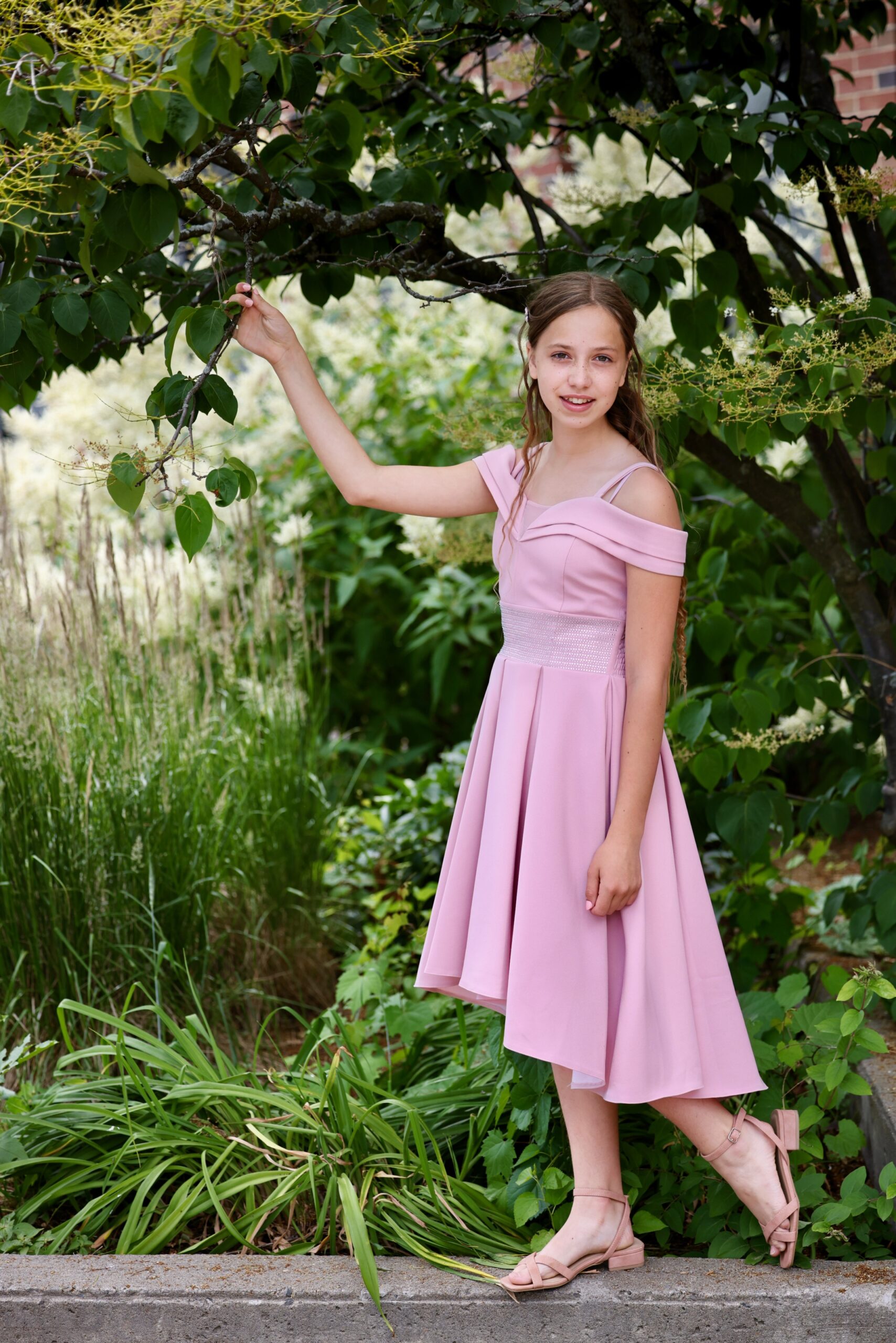
For individual portraits, I prefer to create a small outdoor studio area that feels a little calmer and more personal. Students come one at a time. It is not necessarily a full family portrait. It is really a short moment centered on the graduate.
My goal is not only to create a clean, nice portrait. I try to create an image that says something about the person in front of me.
I often start with a seated pose. It gives me a few seconds to observe how the person naturally positions themselves. Some students are very comfortable. Others are shy. Some have a very strong personal style. Others need gentle direction.
Then I usually move to a standing pose. I may use a tree, a small platform, flowers, tall grass, the surrounding environment, or even a detail from their outfit. Sometimes someone arrives with amazing shoes that really stand out. Sometimes it is the hairstyle, the dress, the suit, the attitude or a small accessory that gives me the idea for the photo.
I often keep flowers nearby. Many girls like them, but some boys also want to use them for fun. And sometimes, those little spontaneous choices create the most natural images.
But all of this has to happen very quickly. In this kind of event, I may have about one minute to one minute and a half per person. That means I have to connect quickly, observe quickly, guide quickly and capture the right expression at the right moment.
For that to work, the administrative part needs to be handled before the session starts.
Why bookings completely change the experience
A booking system changes everything.
Instead of having every family arrive at the same time, appointments help distribute people throughout the available period. Parents know when to come. Students know when to go to the photo area. The photographer can plan the rhythm of the session. The school or organization can manage traffic more easily.
It also gives a much more professional impression. Families feel that the activity is organized. They do not have to wonder if they will get a spot, how they will receive the photos, or who they need to talk to.
For a graduation prom, bookings also help make better decisions before the event even starts. If the time slots fill up quickly, more availability can be added. If demand is higher than expected, the photo session can start earlier, an additional photographer can be added, or someone can be assigned to help manage arrivals.
It is always easier to adjust the plan before the event than to fix the problem on-site when 40 people are already waiting in line.
A concrete example: 15-minute time slots for a prom
For my daughter’s graduation prom at Collège Trinité, the idea is to offer booking slots during the cocktail before the prom. Parents, siblings and family members will be invited, so it is a good moment to take photos before the evening officially begins.
In that context, I am planning to offer 15-minute time slots. If I calculate around one minute and a half per person, that gives me about 10 people per slot.
Of course, real life is never perfect to the second. Some people may arrive a little late. Some students may be talking with friends. One family may have a special request. Something unexpected may happen.
But the time slot gives the session a structure.
With bookings, I can see in advance if all time slots are filling up. I can decide if more availability is needed, if we should start earlier, or if another photographer should help with individual portraits.
Those are the kinds of decisions you want to make before prom night, not while a long lineup is already waiting in front of the photo area.
A photo booking should include more than a time
To me, a photo booking should not only be about choosing a time. It should prepare the whole photo experience.
Yes, the family needs to choose a time slot. But the system should also help manage the number of available spots, the duration of each slot, breaks, buffers, internal notes, the location, forms, consent, photo delivery and even waitlists when needed.
A good booking system should adapt to the real structure of the event.
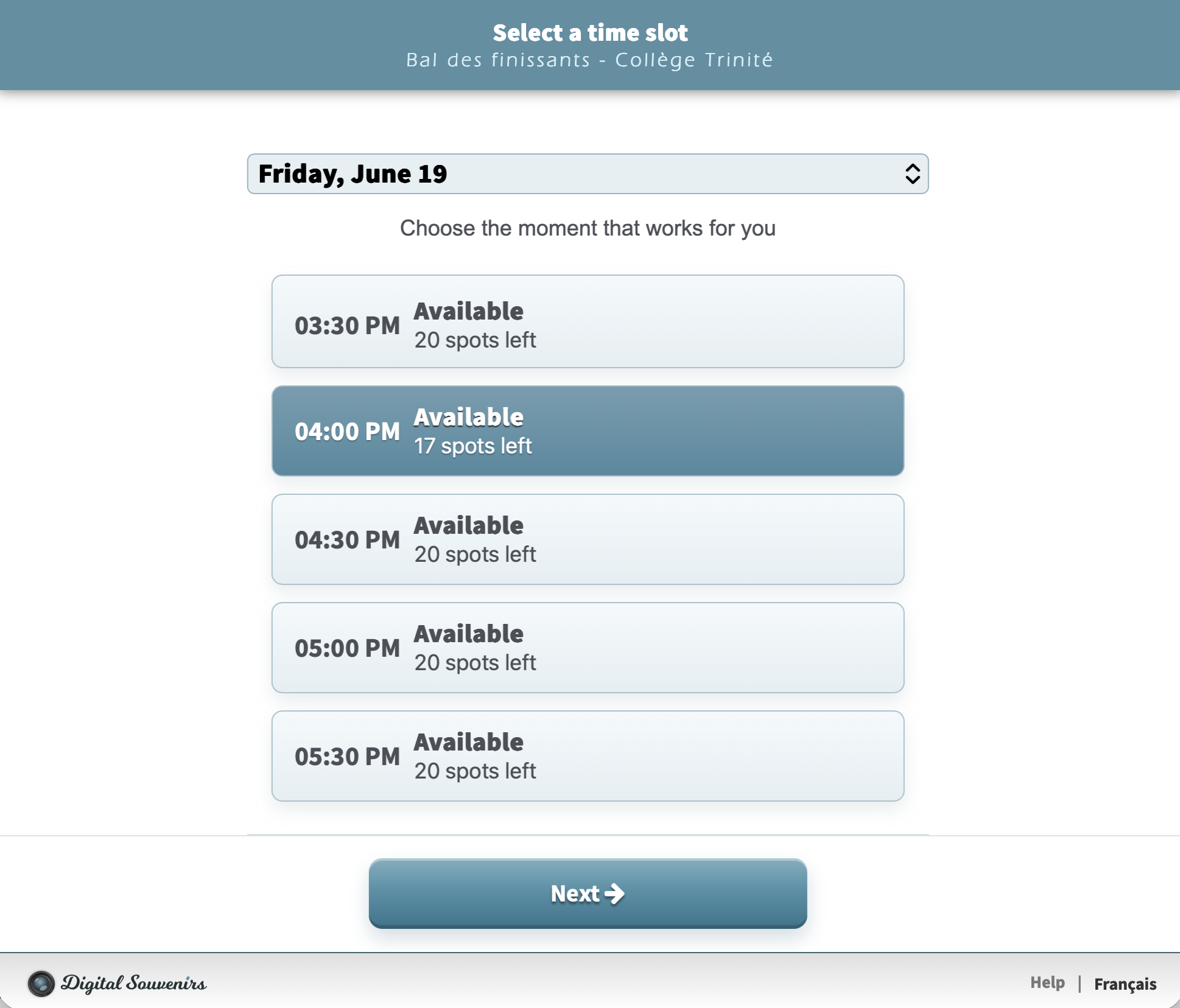
Sometimes, a simple registration is enough. Other times, the photographer needs specific time slots based on the schedule of the event. For a graduation prom, it is often better to offer precise time slots during a specific period, such as the cocktail or the time before the official evening begins.
You also have to think about events that may happen over multiple days, photographer breaks, busier periods, emergency spots and last-minute families.
A buffer between slots can also be useful. Even five minutes can help absorb a delay, reset the space, answer a question or simply give the photographer a few seconds to breathe before the next group arrives.
And when all time slots are full, a waitlist can prevent interested families from being lost. If a spot becomes available, the system can notify families in the order they joined the waitlist. That is much cleaner than trying to manage everything manually by email or text message.
The booking form: collecting the right information from the start
During the booking process, it is also possible to collect the information that will be useful later.
For a graduation prom, the basic information can remain simple: the student’s name, the parent or guardian’s name, the parent’s email address and sometimes an optional note.
The form should not feel like a tax document. If it is too long, people may give up. But it still needs to ask for the right information.
Optional notes can be very useful. A family may want to mention that they really want a photo with a sibling. Another family may want to include an important object. There may be a scheduling constraint, a special situation or a request the photographer should know about.
Fields can be required or optional depending on the situation. The goal is not to make life harder for parents. The goal is to avoid missing important information and to help the photographer have the right details at the right time.
Once again, anything that is handled before the session is one less thing to manage on-site.
Photo consent should be handled before the session
During a graduation prom, many participants are not yet adults. Photo consent is therefore an important part of the process.
I prefer when consent forms are part of the booking flow instead of being handled separately with paper forms, PDFs or scattered emails.
The parent can confirm permission for the photo session. They can accept that the photos will be processed and delivered through a private gallery or secure platform. They can also accept or refuse optional promotional use if that is offered.
It is important to separate the different types of consent. Accepting private delivery of the photos is not the same thing as accepting that images may be used in a portfolio, on a website, on social media or in promotional material.
A family may agree to the photo session and private delivery, but refuse promotional use. And that is completely fine. What matters is that the choice is clear.
I also like when checkboxes are unchecked by default. That way, the parent must take a clear action. They read, they understand, they accept what is required and they can choose whether or not they agree to what is optional.
An electronic signature also adds a more formal confirmation. The parent or guardian can enter their name and confirm that their acceptance acts as an electronic signature. This does not replace legal advice adapted to a specific situation, but it does help centralize consent and clarify what was accepted.
For bilingual events, or for families who are more comfortable in English, having both French and English versions can also make the process clearer.
Private gallery and promotional use are two different things
This is a very important distinction.
When photos are delivered to a family, they are not being published everywhere. They are being delivered to the people concerned, in a private or protected space.
For individual portraits, it is fairly simple: the photo is associated with the student or family who registered. For friend photos, it can be a little different. The same image may involve several students, so it may be accessible to the people who appear in that photo.
But in every case, private delivery should be clearly separated from public use.
A private gallery is for delivering memories to the right people. Promotional use is about showing the photographer’s work, for example in a portfolio, on a website, on social media or in marketing material.
Those are two different uses. And families should be able to understand the difference.
Assigning the right photos to the right people
After the event, the work is not over. The photographer still needs to deliver the right photos to the right families.
That part is often underestimated.
The photographer does not necessarily know every student. In an event with many participants, it can be difficult to know which photo belongs to which person, especially when portraits are taken quickly and many students go through the photo area in a short period of time.
In my system, the booking helps prepare that step. The participant can be associated with a client account, an email address and a private gallery. If they do not already have an account, they can be invited to create one, either with a password or with a sign-in option such as Sign in with Apple.
There can also be a reference photo to help the photographer assign the right images to the right people. The goal is not to replace the photographer’s judgment, but to reduce errors.
Assignment can be assisted by technology, but the final validation remains in the photographer’s hands. That part is important. The system can help suggest matches, but the photographer confirms the assignment.
The goal is simple: avoid sending the wrong photos to the wrong family, avoid missed images and make delivery much more reliable.
What families gain from a clear process
For families, a good process completely changes the experience.
The parent receives a link. They choose a time slot. They fill in the required information. They accept the applicable consent forms. They receive a confirmation. And after the event, they know how the photos will be delivered.
That is much more reassuring.
There is less confusion. Less waiting. Fewer questions. Parents know what to do, when to arrive and how to access the photos afterward.
Depending on the system, they may also be able to change their time slot or cancel their booking if something comes up. That avoids having to contact the photographer for every small change.
For a family already living through a busy and emotional day, the photo experience should feel simple.
What the photographer gains too
For the photographer, the benefit is huge.
Everything is centralized: bookings, client information, consent forms, notes, time slots and delivery. There is no need to manage a paper list, an external form, separate emails and a completely separate delivery system.
The photographer can see how many people are expected. They can know which time slots are full. They can adjust the schedule. They can prepare the lighting, the team and the rhythm of the session based on actual demand.
On-site, there are fewer questions. Less management. Less confusion.
And most importantly, the photographer can focus more on the photos.
Because in the end, that is the real goal. The less the photographer has to manage chaos, the more attention can go to the important details: posture, expression, light, clothing, hair, shoes, accessories and the energy of the person in front of the camera.
What the school or organization gains
The school or organization also benefits directly from a more structured process.
Instead of managing paper forms, repeated questions and families who do not know where to go, the school can simply share one booking link.
Parents register themselves. Consent forms are centralized. Families arrive at better distributed times. There is less crowding around the photo area.
During the event, that improves circulation. Students leave the main activity for less time. They know when to go for their photos, then they can return quickly to enjoy the evening.
For organizers, it removes pressure. For parents, it gives the impression of a well-prepared event.
It is a small organizational difference that can have a big impact on how the entire evening is perceived.
Practical tips to avoid chaos
If you are preparing a prom photo session, a few simple habits can make a big difference.
Create the time slots early enough so families can book in advance. Keep a few backup spots for unexpected situations. Use a waitlist if all time slots are full.
Keep the form simple. Ask only for what is useful. Too many fields can discourage people. Not enough information can make photo delivery harder afterward.
Consent should be clear, simple and separated. Photo permission, private delivery and promotional use should not be mixed into one vague sentence.
A small buffer between some time slots can also help. Five minutes can sometimes save the rhythm of the evening.
I also recommend testing the full booking process before sharing the link: book as if you were a parent, check the form, read the consent text, confirm the booking and look at the confirmation email.
And on-site, having someone at the entrance can really help. That person can check bookings, guide families and prevent the photographer from being interrupted constantly.
Souvenirs Studio: a platform designed from real event experience
This is exactly the kind of reality that led me to develop Souvenirs Studio.
I did not want to build only a booking calendar. I wanted to create a system that understands the full experience of a photo event: bookings, time slots, forms, consent, client accounts, photo assignment and private gallery delivery.
As a photographer, I know how chaotic an event can become when the process is not prepared. As a developer, I wanted to find a way to bring all those steps together in one flow.
The goal is not to make photography colder or more automated. Quite the opposite. The goal is to remove as much administrative friction as possible so the photographer can focus on the people in front of the camera.
A graduation prom goes by fast. Students are proud, nervous, excited and full of energy. Parents are emotional. Everyone wants to keep a memory of that moment.
When the organization is clear, the whole experience becomes better for everyone.
Less chaos, more memories
Organizing prom photos is not only about setting up a camera and waiting for families to arrive.
You need to think about rhythm, waiting lines, consent, contact information, delivery, privacy and the overall experience.
A photo booking should not only be about choosing a time. It should prepare the entire photo experience.
With well-planned time slots, a simple form, clear consent, a waitlist when needed and secure delivery, you reduce the chaos. Families wait less. The photographer works better. The school looks more organized. And students can enjoy more of their evening.
In the end, that is what matters most: creating beautiful memories without turning an important moment into a lineup management problem.