When people think about event photography, they usually imagine the moment the photographer presses the shutter button. But in reality, a huge part of the work begins… after the event is over.
Because once the smiles, portraits, and group photos are done, the real challenge begins:
finding the right people, organizing the images, sending access links, managing downloads, and delivering a professional experience from beginning to end.
And honestly, that’s usually where the chaos starts.
An Event That Perfectly Represents the Challenge
Recently, I had the opportunity to photograph a gala organized by the Centre d’action bénévole de Boucherville to thank their volunteers.
It was an incredible evening.
The dinner was excellent, the atmosphere was warm and welcoming, and there was even a guest performing country dance demonstrations. The entire mayor’s team was present, including Jean Martel himself. Honestly, everything was extremely well organized.
During the evening, I was doing two things at once:
- covering the gala as an event photographer
- running a photobooth at the entrance
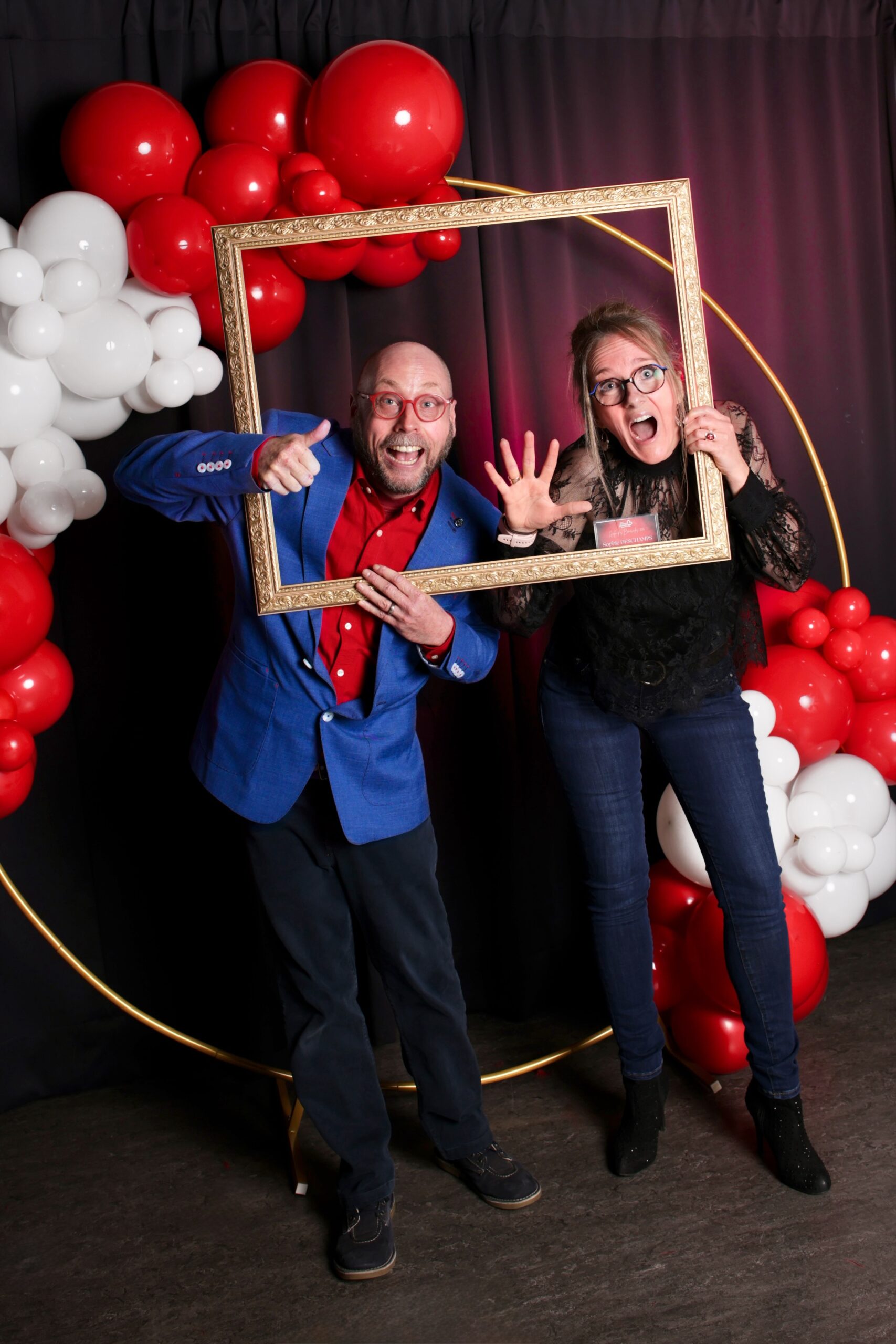
The photobooth featured a large decorative ring filled with red and white balloons matching the organization’s colors. I had installed a Profoto flash powered by batteries with a softbox to keep the setup mobile, fast, and efficient.
Guests arrived one after another, often in couples or groups, and everything had to move quickly.
Very quickly.
Because when there’s a long line of people waiting for photos and the event is running at full speed, there’s very little time to stop and manually write down information.
And that’s exactly where the real challenge of modern event photography begins.
The Hardest Part Isn’t Always Taking the Photo
The most difficult part is not necessarily taking the picture.
Often, the real challenge is:
- collecting participant information correctly
- matching the right photos to the right people
- delivering galleries securely
- avoiding endless technical support afterward
Because once you get home with hundreds — sometimes thousands — of images to process, you still need to organize everything properly.
Historically, many photographers still rely on improvised methods:
- paper sheets
- Excel files
- sticky notes with numbers
- handwritten email lists
- photos of people holding numbers
But in real-world situations, especially during evening events or dark venues, things quickly become complicated.
Pens disappear.
Handwriting becomes unreadable.
Email addresses contain mistakes.
Papers get mixed together.
And honestly, after several hours of photography, the last thing you want is to play detective trying to figure out whether the address was:
“gmail.com” or “gmal.com”.
Why I Started Building My Own Solution
This exact situation is what pushed me to gradually develop my own platform over the years.
At first, I mainly photographed events for friends, schools, and children’s activities. But eventually, the same problem always came back:
how do you efficiently deliver photos to everyone afterward?
I tried different solutions:
- shared albums
- cloud links
- transfer services
- temporary galleries
But as the events became larger, these workflows became less and less realistic.
At some point, you end up dealing with:
- dozens of links
- manually deleting galleries
- people requesting access again
- download problems
- clients losing their photos months later
And most importantly:
it simply doesn’t feel professional anymore.
Turning an iPad Into a Smart Event Kiosk
That’s when the idea for the iPad kiosk was born.
I wanted something:
- simple
- extremely fast
- easy to use
- designed specifically for real events
Today, when an event uses my system, the iPad can be transformed into a fully autonomous registration kiosk.
Participants can:
- enter their name
- type their email address
- create a password
- take a quick profile photo directly from the iPad camera
All with very simple screens designed to keep lines moving smoothly.
And honestly, it completely changes the experience.
Instead of the photographer trying to write notes between groups while a line forms behind them, guests can enter everything themselves.
Even better:
participants can scan a QR code using their phone while waiting in line and complete the registration process before even reaching the camera.
That speeds everything up dramatically.
And when you’re photographing hundreds of people in one evening, every second matters.
Fully Integrated With Client Accounts
One of the biggest game changers with the iPad kiosk is its direct integration with the client account system inside Souvenirs Studio.
Because collecting participant information is only part of the challenge.
The real work begins afterward:
- sending invitations
- managing passwords
- helping clients find their galleries weeks later
- avoiding endless support emails
Before that, traditional workflows often required:
- exporting email lists
- manually creating folders
- sending links individually
- regenerating expired links
- handling forgotten access requests
And honestly, during large events, it quickly becomes overwhelming.
With the integrated kiosk system:
- client accounts are automatically created
- participants are linked to the event
- information is already organized
- galleries are ready for delivery later
Once the photographer finishes processing the images, invitations can automatically be sent to the correct participants.
No more manually managing:
- access permissions
- distribution lists
- expired links
- technical support
Everything is centralized directly inside the platform.
Facial Recognition… Designed Differently
Once the photos are processed, the system can assist with matching the correct images to the correct participants using facial recognition assistance.
However, privacy was extremely important to me.
The system does not use facial data to create permanent user profiles. Temporary data is used only during the photo matching process and is deleted afterward.
I wanted to build a modern workflow while still respecting user privacy.
What Clients Actually Want Today
Client expectations have changed enormously over the years.
Today, people want:
- quick access to their photos
- mobile-friendly galleries
- high-resolution downloads
- secure private galleries
- the ability to easily find favorite images
And honestly, I completely understand why.
When people receive a massive shared folder or a WeTransfer link that expires after a few days, the experience simply isn’t ideal.
Especially when these photos represent important memories.
Bringing Human Interaction Back Into Digital Delivery
One thing I particularly love about a dedicated platform is that it helps recreate a human connection between the client and the photographer.
Because often, once digital galleries are delivered, communication completely stops.
You send a link…
and then silence.
You never really know:
- whether clients loved the photos
- which images created the strongest emotions
- what moments truly mattered to people
That’s why I added a feature allowing clients to thank photographers directly from their galleries.
They can send:
- quick reactions
- prewritten responses
- personalized messages
And honestly, receiving a simple thank-you message after spending hours covering an event feels incredibly rewarding.
Understanding What Works as a Photographer
The platform also tracks useful analytics such as:
- most viewed photos
- favorite images
- HD downloads
As a photographer, that information becomes extremely valuable.
You start understanding:
- which styles connect most with people
- which compositions attract attention
- which moments create emotional impact
It’s a type of feedback that traditional delivery methods rarely provided before.
The Project That Truly Started Everything
The moment everything really changed for me happened during the Sentier des Frissons Halloween event.
Families and children in costumes were coming to take photos after completing the Halloween trail.
There were huge crowds.
And honestly, without an organized system, it would have been nearly impossible to manage efficiently.
During the week before the event, I quickly built the first version of the iPad kiosk directly integrated with my platform.
After the very first event, I realized how dramatically it improved the workflow:
- faster registrations
- fewer mistakes
- better organization
- much easier photo delivery
That’s when I truly understood something important:
The biggest challenge in event photography is not only taking the photos…
…it’s everything that happens afterward.
A Platform Designed for Modern Events
Today, the platform includes features such as:
- secure private galleries
- automatic thumbnail generation
- optimized photo exports
- intelligent watermark placement that avoids faces
- event organization tools
- event booking workflows
- simplified photo delivery
All built around one simple goal:
making event photo delivery smoother for both photographers and clients.
Because in the end, once an event is over, that’s when the memories truly begin.